
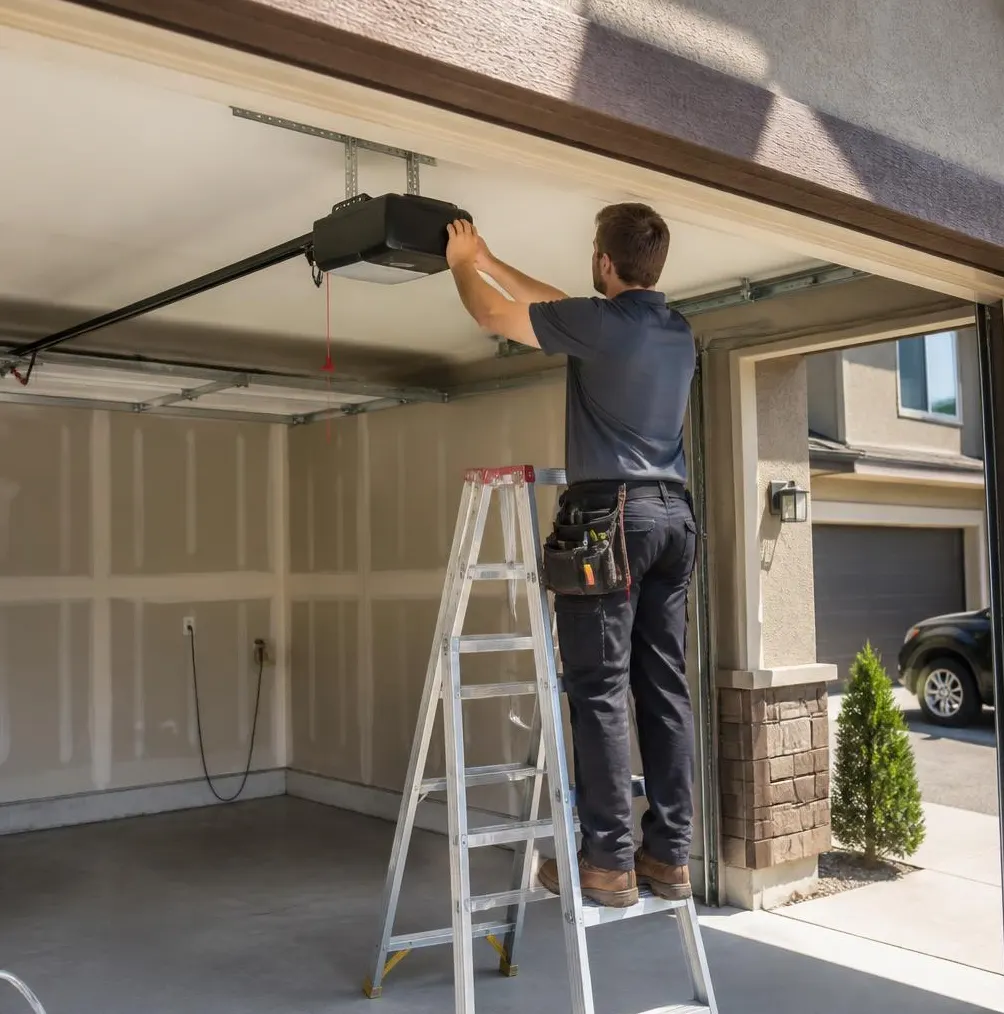
Nine times out of ten, a garage door that won't open has lost power, lost its wireless signal, or lost spring tension — not a burned-out motor. The exceptions are the ones that feel dramatic but are simple: a bumped sensor, a pulled emergency release cord, or a breaker tripped by something else in the garage entirely. Knowing the order a technician checks things in can save you a service call, or at least tell you what to describe when you make one.
What You're Actually Seeing
"Won't open" covers a few different problems, and the symptom often points to the cause before anyone touches a tool:
- Total silence — no light, no hum, nothing happens when you press the button.
- Humming or clicking, but the door doesn't move — the opener has power but isn't engaging the door.
- The opener light blinks a set number of times — many modern openers flash an error code instead of just failing silently.
- The door opens a few inches and reverses or stops — often sensor- or obstruction-related.
- The remote does nothing but the wall button works — a signal problem, not a mechanical one.
- The door won't move even by hand, with the opener disconnected — this points to the springs or cables, not the opener at all.
The Order a Technician Checks Things
1. Power to the Opener
First check is always whether the unit has power. Garage outlets are frequently on GFCI circuits, and those trip easily — more so in humid Missouri summers when moisture gets into the outlet, but a nuisance trip can happen any time of year. The fix is just resetting the breaker or the outlet's test button. If it trips again immediately, that's a wiring issue, not a garage door issue.
2. Remote and Wall Control Signal
Next is whether the opener is receiving a command at all. Dead remote batteries are the most common culprit. Less obvious: a wall-mounted control button with a loose or chewed wire (mice are not shy about garages in the colder months), or a remote that's lost its programming after a power outage. The fix is swapping batteries, checking the wall unit's wiring, or re-syncing the remote to the opener — a five-minute job once you know that's the issue.
3. Safety Sensors (Photo Eyes)
If the opener hums or the light blinks an error code but the door won't move, the two small sensors near the bottom of the track are next. They have to be aligned and have a clear line of sight to each other. A bumped sensor (easy to do when moving bikes, mowers, or holiday storage bins through a tight garage), a cobweb, or condensation fogging the lens can all block the beam. Fix: realign the brackets so both LEDs show solid, and wipe the lenses clean. Humidity swings through spring and summer make fogged lenses a recurring nuisance in this area.
4. The Emergency Release / Trolley Disconnect
Every opener has a red cord that disconnects the door from the carriage for manual operation. If someone pulled it — intentionally during a power outage, or by accident reaching for something stored nearby — the opener will run but the door won't follow it. The fix is simply reconnecting the trolley to the carriage, usually by pulling the release toward the door and running the opener briefly to re-engage it.
5. Springs
If the door won't move even when manually released from the opener, or it feels extremely heavy to lift by hand, suspect a broken torsion or extension spring. Springs are rated for a set number of open-close cycles and simply wear out; cold weather accelerates the risk because metal is more brittle when temperatures drop, and the first hard freeze of the season is a genuinely common time for a spring to finally let go. This is not a DIY repair — torsion springs are under enough tension to cause serious injury, and it's standard for a technician to replace both springs together even if only one has failed, since the second is usually close behind.
6. Cables and Tracks
A frayed or snapped cable will often cause the door to hang crooked or jam partway, rather than refusing to move entirely. Winters here bring road salt and ice spray into garages, and that corrosion works on cables and track hardware over time even if the door is kept inside. A technician checks the cables for fraying at the drum and the tracks for dents, debris, or ice buildup that's binding the rollers. The fix ranges from cleaning and realigning the track to replacing worn cable and rollers outright.
7. The Opener's Motor and Gears
If everything above checks out, the opener itself may have a stripped drive gear (plastic gears wear out with age and heavy summer humidity doesn't help) or a failing circuit board. This is usually the last thing checked because it's the least common cause relative to the mechanical issues above — but it does mean a repair or, for older units, a full replacement.
When to Call Arnold Door & Opener
If you've ruled out power and the remote and the door still won't open — especially if it feels heavy, hangs crooked, or the opener runs without the door moving — that's the point to call rather than keep troubleshooting. A technician can safely diagnose and handle Spring Replacement without the injury risk of doing it yourself, and can take care of Cable & Track Repair if corrosion or a dented track is the real issue underneath. We serve Arnold and the surrounding Jefferson County communities — Imperial, Barnhart, Festus, Herculaneum, Pevely, House Springs, and High Ridge — and we show up with the parts on hand to fix it the same visit in most cases.
If your garage door in Arnold, MO won't open, don't force it by hand or keep hammering the remote button. Call Arnold Door & Opener and we'll get it diagnosed and running safely before winter sets in.